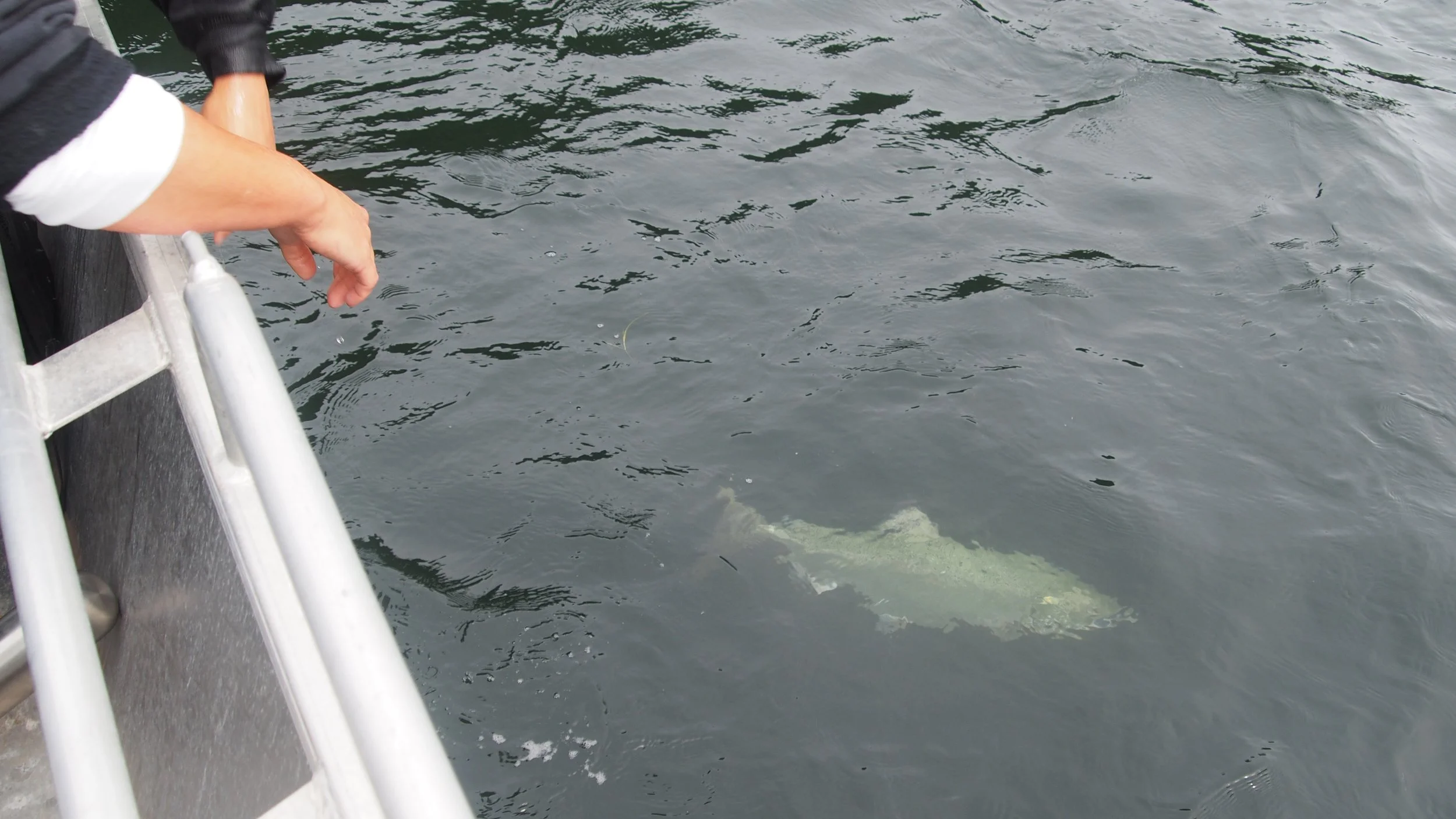
This project was designed to quantify and qualify the terminal survival of adult Chinook Salmon, staging in Cowichan Bay before entering the Cowichan River to spawn. The primary objective was to try to identify where and when mortalities occurred during this staging period (August to November) and what anthropogenic (i.e., log booms, river flows, underwater sound) and environmental (i.e., river flows, river temperatures, size, age) mechanisms had a greater influence on survival to spawn.
The study used Passive integrated transponder (PIT) and acoustic telemetry to track individual fish through the bay, estuary, and lower river corridor. Survival was estimated across discrete river reaches using a network of detection antennas and receivers, allowing survival to be evaluated at a relatively fine spatial and temporal scale. Study design and analysis were developed to produce defensible estimates that could be directly compared across years and management scenarios.
Results provide survival estimates and have identified patterns relevant to recovery planning, habitat restoration, and flow and water-use discussions. The project generated evidence that supports more informed decision-making around the impacts log boom presence has on survival and how freshwater constraints can compound these issues, on Cowichan River Chinook.
Outputs: Technical reports, reach-specific survival estimates, and analytical products supporting recovery planning and adaptive management.

Media Releases

Annual technical report have been developed to fulfill funding requirements. The most recent Year 6 report can be found below.